

A Joint Whitepaper by Planview and Ozmosi
Executive Summary
Pharmaceutical portfolio strategy is entering a new era. For decades, life sciences organizations have invested heavily in internal systems to manage clinical development, allocate resources, forecast outcomes, and optimize R&D decision-making. These systems have created unprecedented visibility into internal pipelines and have helped leadership teams make more precise portfolio decisions.
But internal visibility is no longer enough.
Today’s pharmaceutical strategy is increasingly shaped by external forces: competitor pipelines, emerging science, clinical trial design trends, evolving regulatory dynamics, new mechanisms of action, and shifting therapeutic landscapes. In many organizations, this external intelligence remains fragmented, manually maintained, inconsistently structured, and disconnected from core portfolio planning systems.
That creates a strategic blind spot.
Relying on internal data alone is like playing chess while only being able to see your own pieces. You may understand your position perfectly, but without clear visibility into the rest of the board, your decisions and strategic options are inherently constrained.
This whitepaper, co-authored by Planview and Ozmosi, explores why AI-driven pharmaceutical portfolio strategy requires the integration of internal portfolio data with clean, structured external intelligence. Organizations that unify these data layers will be better positioned to evaluate risk, identify opportunity, respond to competitive threats, and make faster, more confident R&D investment decisions.
What Is External Intelligence in Pharmaceutical Portfolio Strategy?
External intelligence refers to the structured market, scientific, clinical, and competitive data that helps pharmaceutical organizations understand what is happening beyond their own internal pipeline.
In pharmaceutical portfolio strategy, external intelligence may include:
- Competitor pipeline activity
- Clinical trial designs and timelines
- Target and mechanism-of-action data
- Disease area and indication-level activity
- Development stage and regulatory status
- Emerging scientific trends
- Potential acquisition, licensing, or partnership opportunities
- Competitive positioning across therapeutic areas
This information is essential because portfolio decisions are not made in isolation. A program that looks attractive based on internal probability of success, market size, or resource availability may look very different once external factors are considered.
For example, a company may decide to advance a program based on internal forecasts. But without external intelligence, that decision may overlook critical questions:
- How crowded is the competitive landscape?
- Are competitors further ahead in development?
- Are trial designs changing in ways that affect differentiation?
- Is the target or mechanism still commercially attractive?
- Are there emerging assets that could create partnership or acquisition opportunities?
To answer these questions consistently, external intelligence must be clean, structured, and integrated directly into portfolio planning workflows.
The Evolution of Pharmaceutical Portfolio Strategy
Pharmaceutical portfolio strategy has traditionally been built from the inside out.
Organizations have developed sophisticated systems to track clinical progress, model probability of success, allocate capital, and balance portfolios across therapeutic areas. Platforms like Planview Advisor have helped make internal portfolio planning more dynamic, data-driven, and strategically useful.
For many years, this internally focused model was sufficient. Competitive landscapes were often evaluated through static reports, manually intensive research, and periodic portfolio reviews. While imperfect, these approaches created a relatively level playing field. Most organizations were working with similar data limitations and similar update cycles.
That reality has changed.
The introduction of AI into pharmaceutical R&D planning has created a new set of expectations. AI is not simply another analytics layer. It represents a shift in how strategy can be modeled, evaluated, and executed.
For the first time, organizations can continuously assess internal portfolio decisions while also incorporating external market and clinical intelligence into those models. This creates the possibility of a more responsive, more informed, and more competitive approach to pharmaceutical portfolio strategy.
But this shift also introduces a new requirement: data workflows must be AI-ready.
Without clean, structured, and integrated data, AI cannot deliver reliable strategic insights. When the right data foundation is in place, however, AI can evaluate internal and external perspectives together, continuously and at scale.
Organizations that fail to adapt their data infrastructure for this new reality may increasingly find themselves at a competitive disadvantage.
From Static Portfolio Reviews to AI-Driven Strategy
Historically, pharmaceutical portfolio planning has been episodic.
Teams would gather internal data, conduct competitive landscaping exercises, reconcile multiple datasets, and present findings through periodic business reviews. These processes were often resource-intensive, difficult to scale, and inherently retrospective.
AI changes this model.
With the right data foundation, organizations can move from static analysis to continuous portfolio strategy. Internal portfolio decisions, such as trial timing, indication expansion, asset prioritization, or resource allocation, can be modeled dynamically. At the same time, external intelligence can be ingested, structured, and evaluated in near real time.
This enables leadership teams to ask more sophisticated strategic questions.
Not simply:
What should we do?
But:
What should we do given what everyone else is doing right now?
Answering that question requires more than internal data. It requires a unified view of the full pharmaceutical landscape.
Why External Intelligence Matters for AI-Driven Pharmaceutical Portfolio Strategy
AI models are only as valuable as the data they are built upon.
In pharmaceutical strategy, internal data provides the foundation for understanding performance, resources, timelines, and risk. But without external context, AI models operate in a vacuum. They may be able to optimize internal decisions, but they cannot fully evaluate competitive positioning.
For example, an internal portfolio model may suggest advancing a clinical program based on probability of technical success and projected market size. But without external intelligence, that model may not account for:
- How many competitors are targeting the same mechanism
- Whether competing programs are ahead in development
- How clinical trial designs are evolving in that disease area
- Whether differentiation is still achievable
- Whether the commercial opportunity has shifted
- Whether another asset may present a better partnership or acquisition opportunity
This is where external intelligence becomes essential.
It is not merely a supplement to internal planning. It is a core input for AI-driven pharmaceutical portfolio strategy.
However, external data must be structured properly to be useful. Unstructured or inconsistent data introduces ambiguity. That ambiguity can lead to unreliable outputs, flawed recommendations, and increased risk of AI hallucination.
Clean, standardized external intelligence helps solve this problem. When targets, mechanisms, disease areas, development stages, and clinical activities are consistently defined and mapped, AI models can operate with greater clarity and precision.
The result is strategic insight that leadership teams can understand, trust, and act upon.
Why Pharma Companies Struggle to Build External Intelligence Capabilities Internally
Many pharmaceutical organizations recognize the need to connect internal portfolio data with external competitive intelligence. Some attempt to build these capabilities internally by assembling data science teams, developing ingestion pipelines, and standardizing datasets across multiple sources.
While technically feasible, these initiatives are often more complex than they appear.
The challenge is not just engineering. It is domain-specific data modeling.
Clinical and competitive intelligence data requires a deep understanding of how targets, mechanisms, disease areas, modalities, clinical stages, trial designs, and strategic opportunities relate to one another. Without that domain expertise embedded directly into the data layer, standardization efforts often fall short.
Internal teams are also frequently asked to clean and reconcile datasets that were originally created through manual processes. Each dataset may use different definitions, naming conventions, categories, update schedules, and assumptions.
This creates a compounding challenge:
- The data is fragmented
- The definitions are inconsistent
- The workflows are manual
- The external landscape changes continuously
- The strategic context is difficult to model
- The resulting data foundation is often not AI-ready
The result is often a multi-year internal investment that struggles to produce a fully integrated, reliable, and scalable external intelligence layer.
For AI-driven pharmaceutical portfolio strategy, that delay can become a strategic liability.
How Planview Advisor and Ozmosi Support Integrated Portfolio Planning
The path forward is not necessarily to build every capability from scratch. A more effective model brings together best-in-class internal and external data layers.
Planview Advisor provides the internal engine for AI-driven portfolio strategy. It enables organizations to model scenarios, evaluate trade-offs, assess risk, and optimize decisions across complex pharmaceutical R&D portfolios.
With embedded AI capabilities, Planview Advisor helps leadership teams simulate outcomes, explore strategic options, and evaluate portfolio decisions with speed and sophistication.
Ozmosi complements this by providing the external intelligence layer required to contextualize those decisions.
Through a clean, standardized, and continuously updated data foundation, Ozmosi delivers structured insight into the global pharmaceutical development landscape. Targets, mechanisms, disease areas, clinical stages, and competitive activity can be mapped consistently across internal and external datasets, creating a unified, machine-readable view of the ecosystem.
Together, Planview Advisor and Ozmosi enable a new class of strategic capability.
Internal portfolio models can be evaluated not in isolation, but in direct comparison to the external landscape. Competitive dynamics can be incorporated directly into scenario planning. Portfolio gaps can be identified and overlaid with potential acquisition or licensing targets. Strategic decisions can be informed by both internal performance and external opportunity.
This is what it means to see the full board.

Figure 1
Automatically include competitors by disease area, target, or modality directly inside your internal planning system. External intelligence can be connected to competitive intelligence team inputs, creating a more complete view of the strategic landscape.
Turning Pharmaceutical Intelligence into Strategic Action
The integration of Planview Advisor and Ozmosi does more than improve visibility. It accelerates action.
Instead of waiting for periodic competitive landscape updates, leadership teams can continuously monitor relevant changes in the external environment. Instead of reconciling conflicting datasets, they can operate from a more consistent source of truth. Instead of relying on static analyses, they can use AI to dynamically evaluate strategic options.
This shift transforms pharmaceutical portfolio strategy from a reactive process into a proactive capability.
Organizations can identify emerging opportunities earlier, respond to competitive threats more quickly, and allocate resources with greater precision. They can also evaluate whether a given program remains strategically attractive as external conditions evolve.
Most importantly, they can make those decisions with greater confidence because their strategy is grounded in clean, consistent, and comprehensive data.
Figure 2
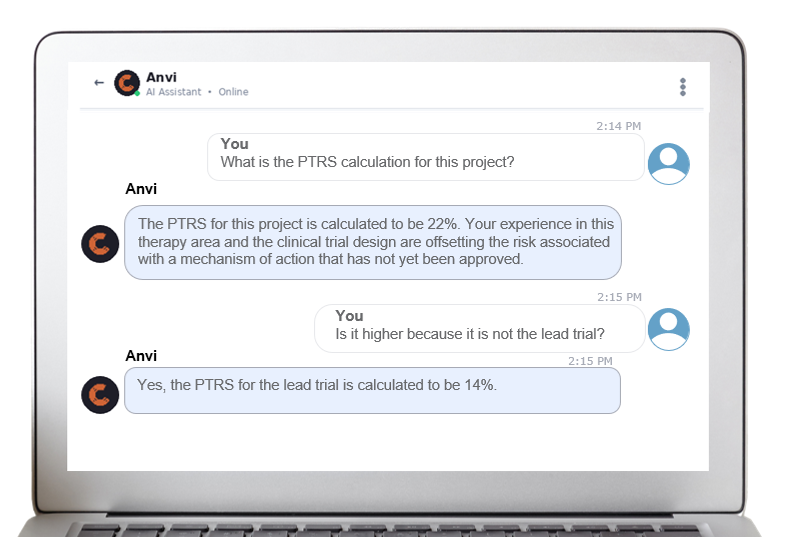
Integrating external data and models into internal planning systems puts the information needed for strategic planning directly at the fingertips of portfolio leaders.
The Competitive Advantage of AI-Ready Pharmaceutical Portfolio Data
AI is not just improving pharmaceutical portfolio strategy. It is redefining it.
The organizations that will lead in this new era will not simply be those with the most advanced models. They will be the organizations with the strongest data foundations.
Specifically, they will be the organizations that can integrate internal portfolio planning data with clean, structured, and continuously updated external intelligence.
Planview Advisor provides the ability to model and optimize internal strategy through AI. Ozmosi provides the external context that ensures those strategies are grounded in the realities of the global pharmaceutical landscape.
Together, they enable a level of strategic clarity that was previously difficult to achieve.
Because in an AI-driven world, seeing only your own pieces is no longer enough.
The companies that can see the full board and act on it in real time will have the strategic advantage.
To learn how Ozmosi’s structured external intelligence can support AI-driven portfolio planning with Planview Advisor, download the full whitepaper or contact the Ozmosi team.